

9 Essential Labrador Nutrition Secrets Every Indian Owner Must Know
Table of Contents
- Why This Labrador Nutrition Guide for India Is Different
- The Labrador’s Unique Health Challenges in India
- Labrador Nutrition Guide India — Puppy Stage
- Labrador Nutrition Guide India — Adult Stage
- Labrador Nutrition Guide India — Senior Stage
- Best Supplements for Labradors in India
- Home-Cooked Labrador Diets in India
- FAQs
If you’ve been looking for a Labrador nutrition guide for India that actually accounts for Indian conditions – the heat, the pet food market, the prevalence of home-cooked diets, and the breed’s very specific vulnerabilities – you’ve found it.
The Labrador Retriever holds the title of India’s most popular dog breed for good reason. They’re loyal, gentle, trainable, and fantastic with families. But what most new Lab owners in India discover quickly is that this breed demands more nutritional attention than almost any other. Obesity, joint disease, skin allergies – all of these are directly influenced by what goes in your Labrador’s bowl every day.
This Labrador nutrition guide for India covers every life stage, every key supplement, and every feeding mistake that’s costing Indian Labrador owners years of their dog’s healthy life.
Why This Labrador Nutrition Guide for India Is Different
Most dog nutrition guides are written for Western markets where the climate is different, the pet food options are different, and the common feeding practices are different. This Labrador nutrition guide for India is built around the specific realities Indian Lab owners face:
- Home-cooked rice-and-chicken diets are common, and almost universally calcium-deficient
- India’s heat and humidity degrade dry kibble quality faster than in cooler markets
- Indian Labs frequently live indoors with lower activity levels than the feeding charts assume
- Joint supplementation is almost never started early enough in India – by the time stiffness appears, significant damage has already occurred
Understanding these realities is the starting point of genuinely good Lab nutrition in an Indian context.
The Labrador’s Unique Health Challenges in India
The POMC Gene – Why Your Lab Is Always Hungry
A study published in Cell Metabolism identified a specific gene variant called POMC deletion in a significant proportion of Labradors. This variant impairs the brain’s satiety signalling – many Labs are genuinely wired to always feel hungry. It’s not greediness; it’s biology. And it makes portion control the single most critical element of any Labrador nutrition guide for India.
The 4 Conditions This Guide Helps You Prevent
Hip and Elbow Dysplasia Labs are among the top breeds for dysplasia diagnosis globally. Nutrition during puppyhood specifically growth rate and calcium balance directly influences severity. Overfeeding accelerates the skeletal deformities that dysplasia causes.
Obesity – India’s indoor Lab population is particularly vulnerable. An overweight Lab experiences accelerated joint wear, reduced cardiovascular efficiency, impaired heat regulation (critical in Indian summers), and a significantly shortened lifespan.
Osteoarthritis – Even Labs without dysplasia develop arthritis from their active lifestyle. Every extra kilogram adds roughly 4 kilograms of compressive force on joints with every step.
Skin and Ear Allergies – Labs are prone to food and environmental allergies that manifest as chronic itching, ear infections, and dull coat. Omega-3 fatty acids are the most impactful dietary intervention for these conditions.

Labrador Nutrition Guide India – Puppy Stage (0-12 Months)
The Phase That Shapes the Next Decade
A Labrador puppy reaches 60–70% of adult body weight within just six months. This rapid growth is why puppy nutrition is the most important section of any Labrador nutrition guide for India – mistakes here have consequences that last the dog’s entire life.
Always choose a large-breed puppy formula. This is the most important rule in this entire guide. Large-breed puppy foods control the calcium-to-phosphorus ratio and calorie density to support steady, controlled bone growth. Generic puppy foods are formulated for small-to-medium breeds – they’re too calorie-dense and have the wrong mineral ratios for a growing Lab.
Puppy Nutritional Targets
| Nutrient | Target | Why It Matters |
|---|---|---|
| Protein | 28–30% | Supports muscle and tissue development |
| Fat | 14–18% | Controls growth rate, prevents excess weight |
| Calcium | 1.0–1.8% DM | Bone formation – balanced, not in excess |
Feeding schedule:
– 8–12 weeks: 4 meals per day
– 3–6 months: 3 meals per day
– 6–12 months: 2 meals per day
Keep your Lab puppy lean. A chubby puppy looks adorable but is actively compressing developing hip and elbow joints — the joints most likely to develop dysplasia in this breed.
Best puppy supplements from this Labrador nutrition guide for India:
– Canina Salmon Oil – start omega-3 supplementation from 8 weeks; supports brain development and provides early anti-inflammatory joint protection
– Canina PUPPY CALCIUM Tablet – provides calcium and phosphorus in the correct ratio for large-breed puppies; not a generic calcium powder
Labrador Nutrition Guide India – Adult Stage (1-7 Years)
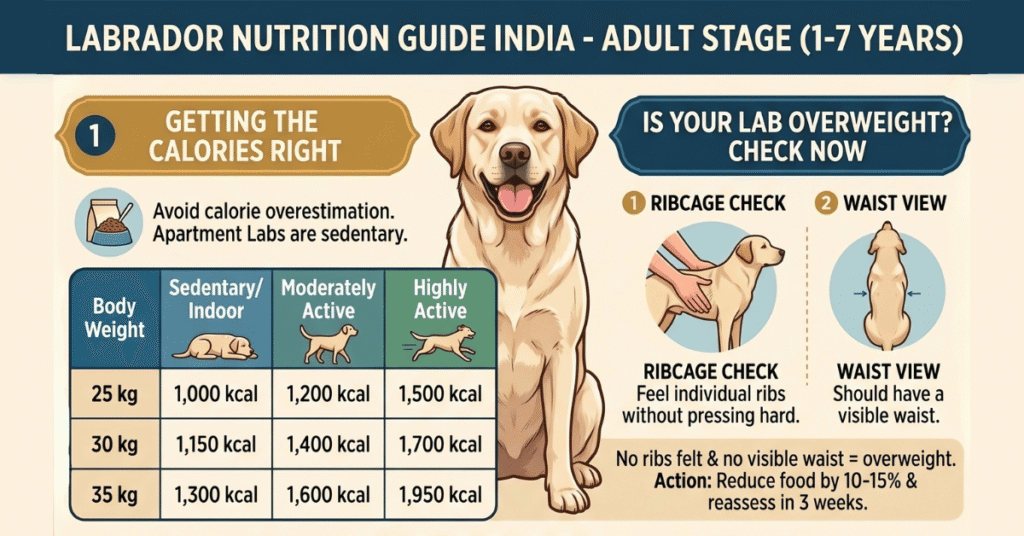
Getting the Calories Right
The most common failure point in any Labrador nutrition guide for India at the adult stage is calorie overestimation. Indian Lab owners routinely overestimate their dog’s activity level. An apartment Lab who gets two 20-minute walks daily is sedentary — not moderately active. Use this as your reference:
| Body Weight | Sedentary/Indoor | Moderately Active | Highly Active |
|---|---|---|---|
| 25 kg | 1,000 kcal | 1,200 kcal | 1,500 kcal |
| 30 kg | 1,150 kcal | 1,400 kcal | 1,700 kcal |
| 35 kg | 1,300 kcal | 1,600 kcal | 1,950 kcal |
Is Your Lab Overweight? Check Now
Run your hands along the ribcage. You should feel individual ribs without pressing hard. View from above – there should be a visible waist. No ribs felt without firm pressure and no visible waist = overweight. Reduce food by 10-15% and reassess in 3 weeks.
What to Look for in Adult Lab Food
According to this Labrador nutrition guide for India, the best adult Lab food has:
– Named animal protein (chicken, lamb, fish) as the first ingredient
– 22–26% crude protein
– 12–16% fat for moderately active dogs
– No artificial colours, flavours, or preservatives
– A “complete and balanced” AAFCO or FEDIAF statement on the label
Common adult feeding mistakes in India:
– Sharing dal, spiced curries, or gravies cooked with onion and garlic
– Free-feeding (leaving food out all day promotes obesity in a breed already prone to it)
– Skipping joint supplementation until limping is obvious – by then, cartilage damage is extensive
– Storing opened food in the original bag in India’s humidity – use an airtight container
Best adult supplements from this Labrador nutrition guide for India:
– Canina CANHYDROX GAG Tablets – start at 2-3 years proactively; glucosamine, chondroitin, and hyaluronic acid at clinically relevant doses
– Canina FLEXAN BioActive Collagen – collagen peptides for tendon and ligament integrity in active Labs
– Canina Salmon Oil – continue omega-3 supplementation throughout adulthood
– Bully Max Muscle Builder – for working Labs, underweight dogs, or those recovering from illness
Labrador Nutrition Guide India – Senior Stage (7+ Years)
The Protein Myth That Hurts Senior Labs
The most important thing this Labrador nutrition guide for India can tell you about senior nutrition: do not reduce protein for your senior Lab. This is one of the most widespread and damaging myths in dog nutrition.
Older dogs are less efficient at absorbing and utilising protein – which means they may need more protein to maintain the same muscle mass, not less. What they need fewer of is calories. Choose a food with 25%+ protein and reduce total quantity if weight is a concern.
Senior Labrador Nutritional Priorities
- Protein 25%+ – prevents sarcopenia (age-related muscle wasting)
- Moderate phosphorus – protects kidney function in older dogs
- Increased omega-3 supplementation – anti-inflammatory support for joints almost certainly showing wear
- High digestibility – senior digestive systems are less efficient; easily digestible proteins matter more
- Dental care – many seniors have dental disease that makes chewing painful; slightly moisten kibble if needed
Complete senior supplement stack from this Labrador nutrition guide for India:
| Supplement | Dose | Benefit |
|---|---|---|
| Canina Salmon Oil | 5-10ml daily | Anti-inflammatory, coat, cognitive support |
| Canina CANHYDROX GAG | Per body weight | Joint cartilage and fluid maintenance |
| Canina FLEXAN | Per body weight | Tendons and ligaments |
| Canina Biotin Forte | As directed | Coat and skin integrity |
Best Supplements for Labradors in India
This section of the Labrador nutrition guide for India focuses on what even premium food fails to provide at clinically useful doses.
Canina Salmon Oil – The single highest-impact supplement for Labs across all life stages. Omega-3 fatty acids address skin allergies, coat quality, joint inflammation, and cardiovascular health simultaneously. Even premium foods include omega-3s below therapeutic levels, and Indian storage conditions degrade them further.
Canina CANHYDROX GAG Tablets – Given the Labrador’s joint disease risk, this is the most important supplement to start in early adulthood. Glucosamine and chondroitin at the doses in CANHYDROX maintain cartilage quality – something no commercial dog food achieves at meaningful concentrations.
Bully Max Muscle Builder – For working Labs, underweight dogs, or those recovering from illness. Rated 4.8★ by verified Indian buyers, Bully Max provides concentrated essential amino acids for lean muscle development.
UPCO Bone Meal Powder – Essential for any Lab on a home-cooked diet. Provides calcium, phosphorus, and magnesium in naturally balanced ratios.
Home-Cooked Labrador Diets in India
Many Indian Lab owners prefer home-cooked meals. This works – but only with proper supplementation. A rice-and-chicken diet without mineral supplementation is one of the most common causes of calcium deficiency and nutritional bone disease in Indian Labs.
A Practical Home-Cooked Framework
Protein (50–60% of meal weight): Boiled chicken (boneless), boiled eggs, cooked fish (boneless). Never use spiced preparations or food cooked with onion or garlic.
Carbohydrates (30–40%): Plain white rice, sweet potato, or oats. Avoid excessive lentils – they produce gas and increase bloat risk.
Vegetables (10–15%): Carrots, peas, green beans, spinach. Avoid onions, garlic, and tomatoes in large amounts.
Mandatory supplements for home-cooked Labs:
– Canina Salmon Oil – omega-3 fatty acids
– UPCO Bone Meal – calcium and phosphorus (1 tsp per 450g of meat)
– Complete vitamin-mineral supplement
– Canina CANHYDROX GAG – from 2 years onwards
For authoritative nutritional standards, see FEDIAF’s nutritional guidelines for complete and balanced dog diets.
Final Thoughts
A good Labrador nutrition guide for India isn’t just a list of foods – it’s a framework for making better decisions at every stage of your dog’s life. Start with portion control and a large-breed formula in puppyhood. Add proactive joint supplementation in early adulthood. Maintain high protein and intensify supplements in the senior years.
The Labrador’s tendency toward obesity, joint disease, and skin issues makes them one of the breeds where nutrition has the most dramatic impact on health outcomes. Feed them right and they’ll reward you with years of enthusiastic, active, joyful companionship.
FAQs
Q1: What is the most important thing in a Labrador nutrition guide for India?
Portion control. The Labrador’s genetic predisposition to always feel hungry means weight management is the owner’s responsibility. An overweight Lab in India faces accelerated joint damage, impaired heat regulation in India’s climate, and a shortened lifespan.
Q2: Why is my Indian Labrador always hungry even after meals?
Many Labradors carry the POMC gene variant that impairs satiety signalling – they’re genuinely neurologically wired to feel perpetually hungry. This is not a behavioural problem. The solution is strict portion control and twice-daily structured meals, not increasing food quantity.
Q3: What supplements does this Labrador nutrition guide for India recommend most?
For Indian Labs specifically: Canina Salmon Oil (omega-3s are degraded by Indian storage conditions, making supplementation especially critical), Canina CANHYDROX GAG from 2–3 years (joint support before damage appears), and UPCO Bone Meal for any Lab on a home-cooked diet.
Q4: When should I transition my Labrador puppy to adult food in India?
Around 12 months for standard Labs. Transition gradually over 7–10 days – replacing 25% of old food every 2-3 days. Abrupt changes cause digestive upset. Once on adult food, reassess calorie needs based on actual body condition, not the feeding chart.
Q5: Can this Labrador nutrition guide for India help with skin allergies?
Yes — skin allergies in Labs are often diet-related or worsened by omega-3 deficiency. Adding Canina Salmon Oil daily is typically the highest-impact single change for Labs with chronic skin issues. If allergies persist, a limited-ingredient diet trial under veterinary guidance is the next step.
Q6: How much water should my Indian Labrador drink?
Approximately 50–60ml per kilogram of body weight per day — more in India’s summer heat. A 30kg Lab needs roughly 1.5–2 litres of fresh water daily. Always keep a clean, filled bowl available. Adequate hydration is often overlooked in Indian conditions and affects coat quality, joint lubrication, and kidney health.
Shop DogsandFur’s complete range of premium imported supplements — specially selected for Labs in Indian conditions. Free shipping across India.